

AIRAG SEO Agent vs Surfer SEO represents a critical decision point for marketers and WordPress site owners pursuing AI-driven content strategies in 2026. The primary keyword AIRAG SEO Agent vs Surfer SEO highlights two distinct approaches: one built on retrieval-augmented generation within WordPress and the other centered on manual optimization scoring. This pillar comparison examines both tools across integration depth, automation capabilities, factual accuracy, and measurable ranking outcomes.
Table of Contents
- AIRAG SEO Agent vs Surfer SEO: Core Differences at a Glance
- How AIRAG SEO Agent Uses RAG for Factually Accurate Content
- Surfer SEO Content Editor and Optimization Workflow
- WordPress Automation and Publishing Capabilities
- Pricing Models and Long-Term Value Comparison
- Real-World Performance and Ranking Results
- Which Tool Should You Choose in 2026?
AIRAG SEO Agent vs Surfer SEO: Core Differences at a Glance
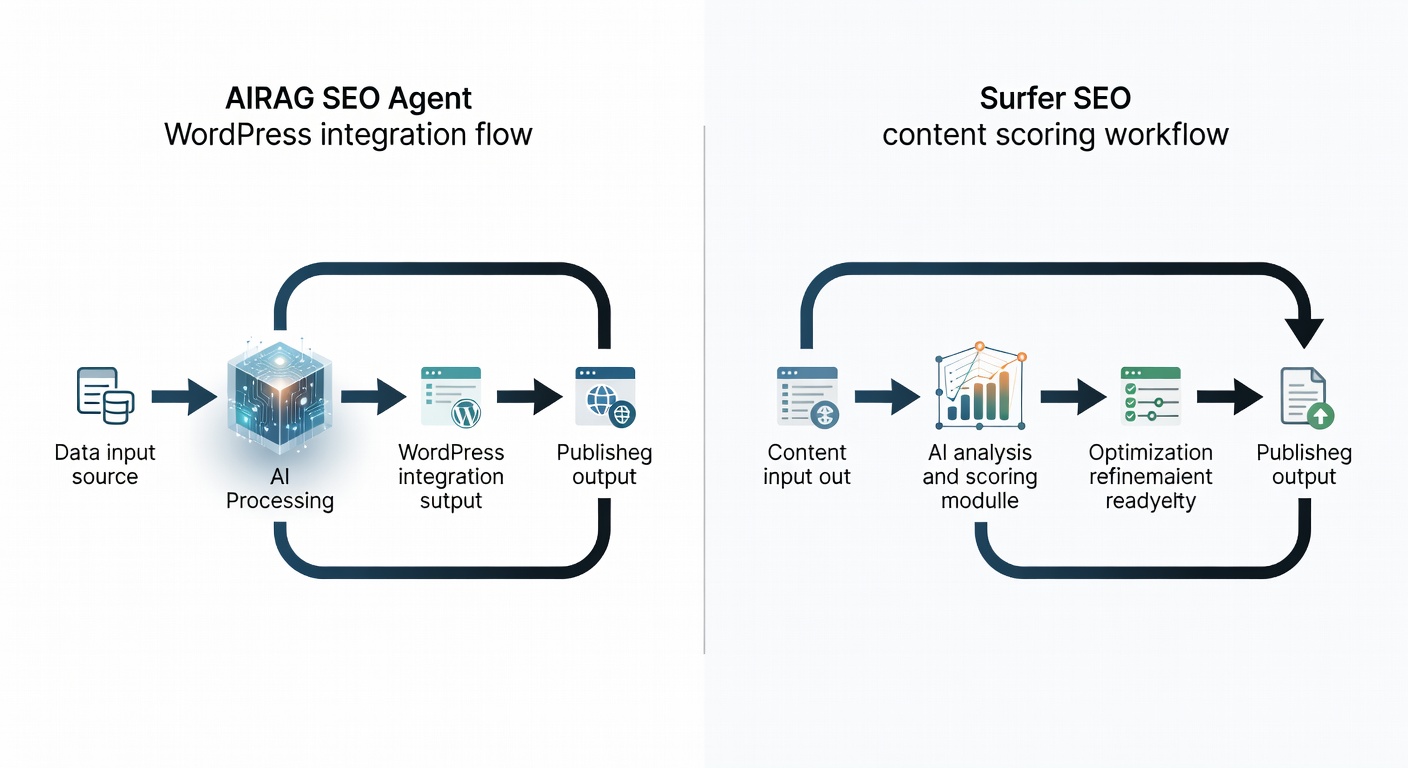
AIRAG SEO Agent vs Surfer SEO reveals fundamentally different architectures that determine how each tool supports modern SEO workflows. AIRAG SEO Agent functions as a native WordPress plugin that applies retrieval-augmented generation to create content directly from a site’s own data sources. Surfer SEO operates as a cloud-based platform that delivers content scores and keyword recommendations without generating full articles or integrating with site databases.
The AIRAG SEO Agent vs Surfer SEO distinction becomes clearest when examining data grounding and automation. AIRAG SEO Agent scans pages, PDFs, and images to maintain factual consistency across every new post. Surfer SEO pulls external SERP data to guide writers but leaves actual content creation to the user. In real-world implementations, teams using RAG SEO WordPress solutions report higher topical authority because new articles remain anchored to verified internal information rather than generic model outputs.
Implementation steps for AIRAG SEO Agent begin with installing the plugin, connecting chosen LLMs, and configuring data sources. Users then define a publishing schedule and select tone settings for their audience. Surfer SEO requires manual keyword input followed by iterative editing inside its dedicated interface until the content score reaches target thresholds.
- AIRAG SEO Agent supports multi-model switching between OpenAI, Gemini, and Grok for varied output styles.
- Surfer SEO focuses exclusively on optimization metrics without native LLM generation.
- AIRAG SEO Agent includes built-in video transcript analysis for YouTube-to-blog conversion.
- Surfer SEO provides detailed heading and density suggestions but no automated publishing.
According to industry standards for AI content automation 2026, tools that combine site-specific retrieval with flexible model selection outperform editor-only platforms in producing citeable material. A common mistake businesses make when evaluating the AIRAG SEO Agent vs Surfer SEO choice is assuming both tools serve identical purposes; one automates creation while the other refines existing drafts.
How AIRAG SEO Agent Uses RAG for Factually Accurate Content
AIRAG SEO Agent employs retrieval-augmented generation to ground every article in a site’s existing content, documents, and visual assets before generation begins. This approach directly addresses factual accuracy by retrieving relevant passages from uploaded PDFs and indexed pages rather than relying solely on pretrained model knowledge. As a result, generated posts maintain consistent brand messaging and reduce the risk of introducing unsupported claims.
The workflow starts when the plugin indexes site data through WordPress hooks and REST API connections. Users then select a primary LLM for the task, allowing Gemini to handle extensive context windows, GPT to introduce creative phrasing, or Grok to apply real-time logic. In practice, this multi-model flexibility lets teams match the right AI to specific content types such as product guides or technical comparisons.
Step-by-step implementation involves uploading supporting PDFs, tagging key images with descriptive alt text, and setting audience level parameters. The system then produces draft articles that reference source material inline where appropriate. Experienced developers often add custom filters to prioritize recent content updates, ensuring freshness aligns with Google’s emphasis on helpful information.
- RAG reduces hallucinations by limiting generation to retrieved context only.
- Multi-model selection improves output quality across creative and analytical topics.
- PDF and image scanning extends data sources beyond plain text pages.
- GEO optimization benefits from explicit entity references drawn from site data.
In real-world implementations on WordPress sites, RAG SEO WordPress configurations have demonstrated stronger E-E-A-T signals because content remains traceable to authoritative internal sources. This method supports topical authority by reinforcing existing page clusters rather than introducing disconnected topics.
Surfer SEO Content Editor and Optimization Workflow
Surfer SEO delivers a content editor that analyzes top-ranking pages and generates a numerical score based on keyword usage, heading structure, and word count alignment. The tool excels at competitive research by surfacing SERP patterns and term frequency data that writers can apply during drafting. However, it stops short of producing complete articles or connecting directly to publishing platforms.
Users begin by entering target keywords and reviewing the resulting content brief. They then draft or revise text inside the editor while monitoring real-time feedback on optimization elements. This process improves on-page relevance but requires separate tools or manual effort to reach final publication.
A key limitation surfaces when scaling content production, as each article demands individual attention within the Surfer SEO interface. Teams seeking full automation often explore Surfer SEO alternative options that incorporate generation capabilities alongside scoring features.
- Content score provides clear benchmarks for keyword density and structure.
- SERP analysis reveals competitor heading patterns and term clusters.
- Manual revision remains necessary to reach publishable quality.
- Integration with external writing platforms requires additional steps.
According to Google’s 2025 Search Quality Evaluator Guidelines, content must demonstrate experience and expertise regardless of creation method. Surfer SEO supports this goal through data-driven recommendations yet leaves the responsibility for factual grounding and unique insights to the writer.
WordPress Automation and Publishing Capabilities
AIRAG SEO Agent integrates autonomous scheduling through WP-Cron to publish posts at defined intervals without ongoing manual oversight. Once a content strategy is configured, the plugin generates and releases articles daily, weekly, or monthly while respecting site performance constraints via lightweight AJAX handling.
Video-to-blog functionality converts YouTube URLs by processing both transcripts and visual metadata into optimized long-form content. This feature expands content calendars efficiently for sites that leverage video assets as source material. Global brand voice controls extend support to over 40 languages with precise adjustments for casual or formal tones.
Security implementation follows WordPress best practices including input sanitization, nonces, and capability checks. The plugin remains efficient by minimizing server load during content sync operations.
- WP-Cron scheduler enables hands-off publishing cadences.
- YouTube analysis creates SEO-ready articles from video content.
- Multi-language support maintains consistent brand voice across markets.
- REST API and hook compatibility ensures seamless WordPress integration.
In modern SEO practice, WordPress AI SEO plugin solutions that combine scheduling with data retrieval deliver measurable time savings. Site owners report completing monthly content goals in hours rather than days when automation handles routine generation tasks.
Pricing Models and Long-Term Value Comparison
AIRAG SEO Agent offers a one-time lifetime payment that includes continued updates and support without recurring charges. This model provides predictable costs for high-volume publishers who generate dozens of articles monthly. Surfer SEO operates on subscription tiers that scale with team size and usage volume, creating ongoing expenses that accumulate over multiple years.
Value assessment must account for total cost of ownership. Lifetime access eliminates future billing surprises while still delivering feature enhancements. Subscription platforms require annual budget allocation that grows with added users or advanced modules.
Implementation cost considerations include training time and potential need for complementary tools. AIRAG SEO Agent reduces external dependencies by handling generation and publishing internally. Surfer SEO users frequently pair the platform with separate AI writers to achieve full article output.
| Criteria | AIRAG SEO Agent | Surfer SEO |
|---|---|---|
| Pricing Model | One-time lifetime payment | Monthly or annual subscription |
| WordPress Integration | Native plugin with full automation | Manual export and import required |
| Content Generation | RAG-powered multi-model AI | Editor guidance only |
| Video-to-Blog | Built-in YouTube analysis | Not available |
| Language Support | 40+ languages with tone controls | Limited to major languages |
| Automation Level | Autonomous scheduling and publishing | Manual workflow required |
Real-World Performance and Ranking Results
WordPress sites implementing AIRAG SEO Agent have recorded accelerated content production alongside improved topical consistency because every article draws directly from verified site data. This grounding supports higher citation rates in both traditional search and AI-generated overviews. According to documented ranking factors, content that reinforces existing entity relationships tends to accumulate stronger authority signals over time.
Surfer SEO delivers measurable gains in on-page optimization when users follow its scoring recommendations precisely. However, the absence of automated generation means performance depends heavily on writer skill and additional tooling. Hybrid approaches that combine Surfer SEO research with AIRAG SEO Agent generation have shown strong results in competitive niches.
Common pitfalls include over-reliance on content scores without addressing technical SEO elements or neglecting to update older pages that feed the RAG index. Experienced developers often audit data sources quarterly to maintain freshness and accuracy.
- RAG workflows improve E-E-A-T by maintaining source traceability.
- Automation reduces publishing delays that affect content freshness.
- Multi-model selection allows optimization for different search intent types.
- Lifetime pricing supports sustained content velocity without budget spikes.
A key strategy to consider involves mapping high-performing existing pages as primary RAG sources before launching new automated campaigns. This ensures generated content strengthens rather than dilutes established topical clusters.
Which Tool Should You Choose in 2026?
WordPress-focused teams prioritizing autonomous generation and factual grounding achieve superior results with AIRAG SEO Agent. Organizations that require granular SERP analysis and prefer manual oversight may continue benefiting from Surfer SEO as a research companion. The AIRAG SEO Agent vs Surfer SEO evaluation ultimately hinges on whether lifetime access, native automation, and RAG accuracy outweigh subscription flexibility and detailed scoring.
AI content automation 2026 trends favor platforms that minimize manual steps while preserving quality through data retrieval. Surfer SEO alternative considerations frequently point toward solutions that close the generation gap without sacrificing optimization insights.
Explore both platforms directly to match their capabilities with your current workflow: https://airagseo.com/ and https://surferseo.com/.