

Generative Engine Optimization has become essential for brands seeking visibility as users turn to AI platforms for direct answers rather than traditional search result lists. In 2026, platforms such as Perplexity, Gemini, and Google AI Overviews generate single summarized responses that reduce the need for multiple site visits, making citation within those summaries the new measure of discoverability.
Content that earns these citations must demonstrate factual precision, clear structure, and topical authority. Brands that adapt their processes to these requirements maintain presence across both classic search and emerging AI interfaces.
Table of Contents
- Why Traditional SEO No Longer Guarantees Visibility in AI Answers
- Core Principles That Make Content Citeable by Generative Engines
- Practical Shifts Brands Must Make in 2026
- How Automated Tools Support Consistent GEO Execution
- Frequently Asked Questions
Why Traditional SEO No Longer Guarantees Visibility in AI Answers
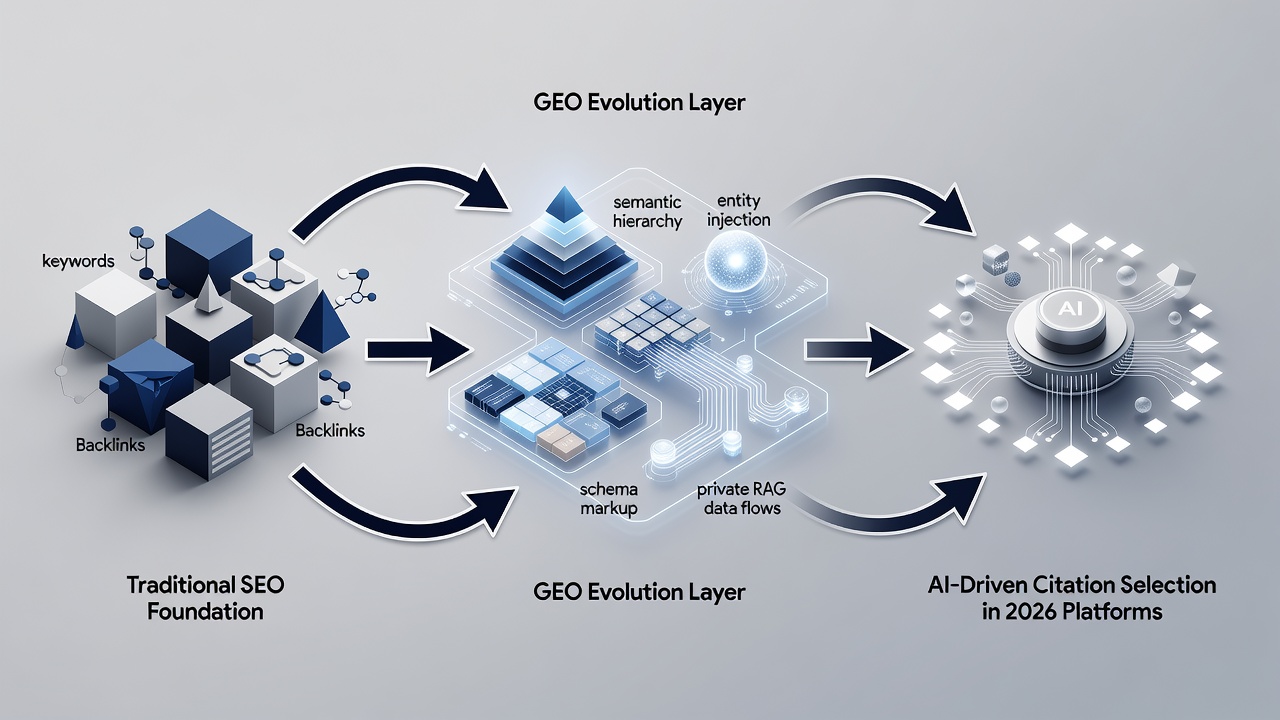
Traditional SEO optimized pages for rankings, backlinks, and click-through rates, yet current AI search systems select sources based on semantic clarity, factual specificity, and structural readability instead. High positions in classic results often fail to translate into inclusion within AI-generated answers because the evaluation criteria have shifted toward content that supports direct, verifiable responses.
Current 2026 observations indicate that generative engines favor materials containing explicit entity relationships and answer-first formatting over pages built primarily around keyword density. This creates a measurable gap where traffic-focused strategies alone no longer ensure presence in conversational or summarized outputs.
How AI search platforms select and summarize sources
AI platforms scan large volumes of content to identify passages that directly address user queries with minimal ambiguity. They prioritize sections that begin with concise definitions or summaries, followed by supporting details such as data points, comparisons, or procedural steps. This selection process favors content that can be extracted and synthesized without extensive rewriting.
In practice, platforms evaluate trustworthiness through consistent terminology, clear source attribution, and alignment with established entities. Content lacking these elements receives lower priority even when it ranks well in traditional indexes.
The gap between Google rankings and citation inclusion
Google rankings reward factors such as domain authority and backlink profiles, while citation decisions in AI systems emphasize immediate usability and factual grounding. A page that appears on the first page of classic results may still be overlooked if it lacks hierarchical headings, embedded schema, or specific details drawn from unique data sources.
Experienced teams note that this disconnect appears most clearly in B2B and SaaS sectors where technical documentation often ranks highly yet rarely appears in AI summaries unless reformatted for conversational clarity and entity coverage.
Core Principles That Make Content Citeable by Generative Engines
Content earns citations when it supplies AI systems with readily extractable, authoritative information organized through semantic hierarchies and supporting markup. This requires deliberate attention to answer placement, entity relationships, and the integration of private knowledge that distinguishes the material from generic sources.
These principles operate together: semantic structure provides clarity, entity optimization signals context, and private data ensures specificity that generic generation cannot replicate.
Semantic structure and answer-first formatting
Each major section should open with a standalone one- or two-sentence answer that addresses the implied query. Subsequent paragraphs then expand with examples, lists, or data without requiring the reader to infer the main point. This pattern matches how generative engines retrieve and assemble responses.
Real-world implementations show improved citation rates when headings use descriptive phrasing that mirrors common user questions. Bullet lists and numbered steps further aid extraction by breaking complex information into discrete units.
Entity relationships and schema implementation
Explicit mention of related entities such as tools, processes, or industry standards helps AI systems map content to broader knowledge graphs. Automatic inclusion of Schema.org markup for articles and FAQs reinforces these relationships and provides machine-readable context that improves selection probability.
Teams that maintain consistent entity terminology across multiple posts build cumulative topical authority. This consistency allows generative engines to recognize the source as a reliable reference within specific domains.
Use of private data for factual specificity
Retrieval-augmented approaches that reference internal documents, product information, or case studies produce content containing details unavailable in public training data. Such specificity increases the likelihood of citation because the material offers unique value that cannot be synthesized from generic sources alone.
Industry patterns in 2026 demonstrate that organizations maintaining private knowledge bases achieve higher attribution rates in AI outputs across healthcare, finance, and technology verticals.
Practical Shifts Brands Must Make in 2026
Successful adaptation involves replacing fragmented keyword targeting with comprehensive topical resources that address clusters of related questions. Regular publication of structured, expert-informed content combined with automated formatting maintains relevance across evolving AI evaluation methods.
Measurement moves from traffic volume toward citation frequency and mention accuracy in generative responses.
Moving from keyword pages to deep topical assets
Deep topical assets cover subtopics, comparisons, and implementation details within a single resource. These assets establish authority by answering adjacent questions that users frequently pose in conversational interfaces.
Common pitfalls include publishing isolated articles that lack internal connections or entity coverage. Such isolated content rarely accumulates the contextual signals generative engines require for consistent selection.
Automating structured, citation-optimized publishing
Automation of tables of contents, FAQ sections, and schema markup reduces formatting inconsistencies while ensuring every post meets structural standards. This consistency supports ongoing updates that keep material current without proportional increases in manual effort.
Observed outcomes in SaaS and e-commerce environments show that teams adopting structured automation publish at higher frequency while maintaining the clarity needed for AI citation.
| Traditional SEO Signals | GEO Citation Signals |
|---|---|
| Keyword density and rankings | Semantic hierarchy and answer-first sections |
| Backlink volume | Entity relationships and schema markup |
| Click-through rates | Factual specificity from private data |
| Page load speed | Structured elements (TOC, FAQ, tables) |
| Meta descriptions | Direct alignment with conversational queries |
Measuring success through AI mention frequency
Tracking citations in platforms such as Perplexity and Gemini provides direct feedback on optimization effectiveness. Brands can identify which content elements correlate with inclusion and refine future production accordingly.
This measurement approach reveals patterns that classic analytics miss, such as the impact of specific heading phrasing or the presence of comparison tables on selection rates.
How Automated Tools Support Consistent GEO Execution
Specialized automation platforms combine multiple AI models with private knowledge synchronization to produce content that meets both semantic and structural requirements. These systems detect intent, apply consistent formatting, and maintain brand terminology across languages and topics.
Integration with existing publishing environments allows teams to scale output while preserving the factual grounding that supports citation.
Multi-model AI combined with site-specific knowledge
Using different models for distinct tasks, such as logic verification or creative expansion, improves overall accuracy. When these models reference synchronized private documents, the resulting content reflects accurate business context rather than generalized patterns.
Experienced practitioners observe that this combination reduces hallucinations and increases the presence of verifiable details that AI engines prefer when selecting sources.
Automatic schema, TOC, and FAQ generation
Automated generation of hierarchical headings, clickable tables of contents, and JSON-LD enabled FAQs ensures every article meets current formatting expectations. These elements simplify extraction for generative engines and improve readability for human audiences as well.
Teams report fewer manual revisions when these structural components are produced automatically during the drafting stage.
Secure knowledge synchronization for unique brand voice
Local storage of documents and site content enables content generation that matches established terminology and tone. This synchronization supports consistent attribution across multiple platforms while protecting proprietary information.
Organizations in regulated industries particularly benefit from this approach because it maintains factual control without external data transmission.
Frequently Asked Questions
What is the main difference between SEO and GEO in practice?
Traditional SEO targets rankings through keywords and backlinks, while Generative Engine Optimization focuses on producing structured, factual content that AI systems select and cite in their summaries.
Which content formats do AI engines cite most frequently?
AI engines most often reference materials with answer-first sections, semantic hierarchies, entity relationships, schema markup, and specific facts drawn from authoritative private sources.
Can existing SEO workflows be adapted for generative search?
Yes, existing workflows can incorporate automated structuring tools, private knowledge integration, and citation-focused formatting to bridge traditional SEO with Generative Engine Optimization requirements.
Organizations exploring these adaptations in greater detail can review available resources at https://airagseo.com/.