WordPress RAG Content Generator Setup with AIRAG SEO Agent (2026)
A WordPress RAG content generator setup is the configuration of AIRAG SEO Agent to index site PDFs, images, and pages through Retrieval-Augmented Generation, then generate SEO-optimized articles using multiple LLMs while maintaining factual accuracy and brand alignment for superior search visibility and AI Overview citations.
Table of Contents
- WordPress RAG Content Generator Setup Fundamentals
- How AIRAG SEO Agent Implements Retrieval-Augmented Generation
- Multi-LLM Architecture Inside the AIRAG SEO Agent Engine
- Autonomous Scheduling and Publishing Workflows
- Video-to-Blog Intelligence Feature Breakdown
- AIRAG SEO Agent versus Traditional AI Writing Tools
- Implementation Best Practices for Maximum Search Visibility
- Pro Tips for WordPress RAG Content Generator Setup
- Common Pitfalls in WordPress RAG Content Generator Setup
WordPress RAG Content Generator Setup Fundamentals
WordPress RAG content generator setup refers to the configuration of an AI-powered system that indexes proprietary site content before generating new articles, ensuring every output remains aligned with existing brand data and topical authority signals. In modern business practice, this approach addresses the core limitation of generic AI writing tools that produce plausible but unverified text. AIRAG SEO Agent solves this by grounding outputs in site-specific documents, reducing hallucinations and improving citation potential in AI Overviews. The system supports more than 40 languages, making it suitable for global WordPress sites that require localized yet accurate material.
How AIRAG SEO Agent Implements Retrieval-Augmented Generation
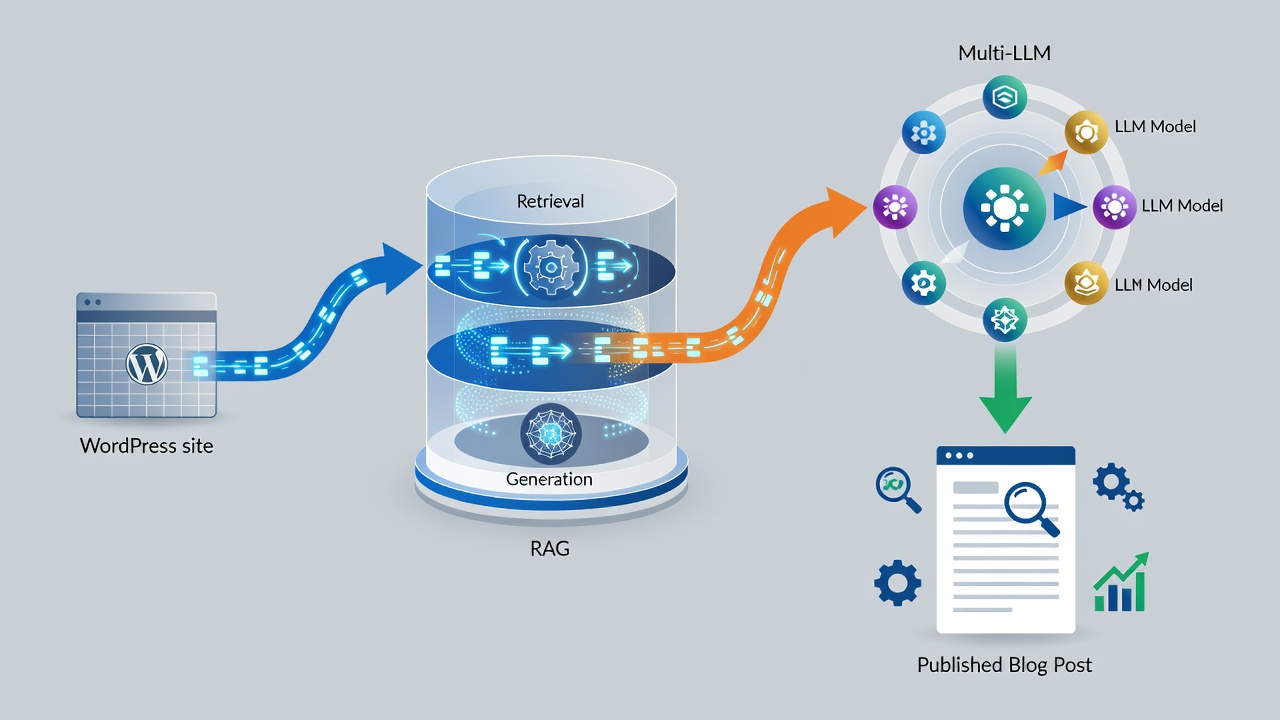
AIRAG SEO Agent implements Retrieval-Augmented Generation by first scanning uploaded PDFs, images, and existing WordPress pages to build a private knowledge index that guides every subsequent generation step. This process ensures content matches the site unique knowledge base. In real-world implementations, this grounding process prevents generic hallucinations and produces content that matches a site messaging for improved citation potential in AI Overviews. The engine follows WordPress coding standards, uses REST API and AJAX for efficient operation, and applies security best practices including input sanitization and capability checks.
Multi-LLM Architecture Inside the AIRAG SEO Agent Engine
AIRAG SEO Agent provides seamless switching between Gemini for large context windows, GPT for creative phrasing, and Grok for real-time logic, all while routing outputs through the same RAG index for factual consistency. Users select Gemini for handling large context windows, GPT for creative phrasing, or Grok for real-time logic, all within one secure dashboard. The system processes internal site content through RAG before any generation begins. In real-world implementations, this multi-model approach ensures content remains consistent with brand voice while adapting tone from casual to formal.
Autonomous Scheduling and Publishing Workflows
AIRAG SEO Agent uses WP-Cron to execute daily, weekly, or monthly publishing schedules once a content strategy is defined inside the Autonomous Schedule Manager, removing all manual intervention after initial setup. This removes manual intervention while maintaining consistent output volume. Global Brand Voice controls let administrators set audience level and tone parameters that persist across all generated posts, ensuring stylistic coherence regardless of which LLM produces the draft.
Video-to-Blog Intelligence Feature Breakdown
Video-to-Blog Intelligence in AIRAG SEO Agent automatically extracts key points from any YouTube URL by analyzing both transcripts and visual metadata, then structures the material into long-form, SEO-optimized WordPress posts ready for immediate publication. The AI analyzes both transcripts and visual metadata to extract key points and structure them for search rankings. This feature transforms any YouTube URL into a long-form, SEO-optimized article while keeping every output aligned with site data through the RAG pipeline.
AIRAG SEO Agent versus Traditional AI Writing Tools
| Feature | AIRAG SEO Agent | Generic AI Plugins |
|---|---|---|
| RAG Grounding | Yes – scans PDFs and images | No |
| Video to Blog | Yes – full transcript analysis | Limited |
| Autonomous Scheduling | WP-Cron daily/weekly/monthly | Manual only |
| Multi-LLM Support | Gemini, GPT, Grok | Single model |
According to industry standards for factual AI writing, grounding outputs in site data leads to higher citation rates in both traditional search and AI-powered answer engines. Traditional AI tools generate text without reference to a site proprietary documents. AIRAG SEO Agent, as an AI content engine for WordPress, first indexes pages, PDFs, and images, then uses that indexed knowledge to guide every output.
Implementation Best Practices for Maximum Search Visibility
Define a clear content strategy inside the Autonomous Schedule Manager before activating automation. Specify target keywords, desired word counts, and publishing cadence to align generated posts with overall SEO goals. A common mistake businesses make is running the engine without first uploading relevant PDFs and images that represent core expertise. Monitor the first batch of published posts for tone consistency and factual alignment, then adjust audience level and brand voice settings as needed. This iterative process maximizes the value of the AI content engine for WordPress over time.
Pro Tips for WordPress RAG Content Generator Setup
- Upload core PDFs and images representing site expertise before activating any automation schedules to ensure RAG grounding delivers accurate results from the first batch.
- Leverage Gemini for large context windows when generating comprehensive guides and switch to Grok for logic-heavy technical posts within the same dashboard.
- Set persistent Global Brand Voice controls at the audience level matching your target readers to maintain stylistic coherence across multi-LLM outputs.
- Review the first published posts for citation alignment with AI Overviews and refine keyword targeting inside the Autonomous Schedule Manager accordingly.
Common Pitfalls in WordPress RAG Content Generator Setup
- Skipping the initial upload of site-specific PDFs and images leads to generic outputs that fail to improve topical authority signals.
- Neglecting to define publishing cadence and word count targets in the Autonomous Schedule Manager results in inconsistent output volume and SEO misalignment.
- Using a single LLM without testing model switches reduces the ability to optimize for context, creativity, or real-time logic needs.
- Ignoring tone consistency checks after the first batch prevents iterative improvements that maximize long-term citation rates in search engines.
Ready to turn your WordPress site into an AI-driven content machine? Get lifetime access to AIRAG SEO Agent today.
Frequently Asked Questions
What is an AI content engine for WordPress and how does it use RAG?
An AI content engine for WordPress uses Retrieval-Augmented Generation to scan site pages, PDFs, and images and produce factually grounded articles.
How can I convert YouTube videos into SEO articles automatically in WordPress?
AIRAG SEO Agent analyzes video transcripts and visual metadata to create long-form, SEO-optimized posts from any YouTube URL.
Which AI models work best for generating accurate WordPress blog content from my own PDFs and images?
AIRAG SEO Agent lets users switch between Gemini for context, GPT for creativity, and Grok for logic while grounding every output in site-specific data.
Connect with a specialist to configure AIRAG SEO Agent for your WordPress site and begin generating high-ranking content automatically. Explore AIRAG SEO Agent Features